How to Take Someone's Name Off Your Property Title
Last updated: October 14, 2026
When someone who no longer shares the property is still named on the title, such as a relative added years ago or a former co-owner, the fix is a quitclaim deed from that person to you. They sign it in front of a notary, it's recorded in the county where the property is located, and whatever interest they had passes to you.
An example: a brother added years ago
Grace Chen added her brother, Tom, to the title of her property in 2015, when she was refinancing and wanted a co-signer. Tom has never lived there, and they both see the property as Grace's. To make the record say so, Tom signs a quitclaim deed to Grace.
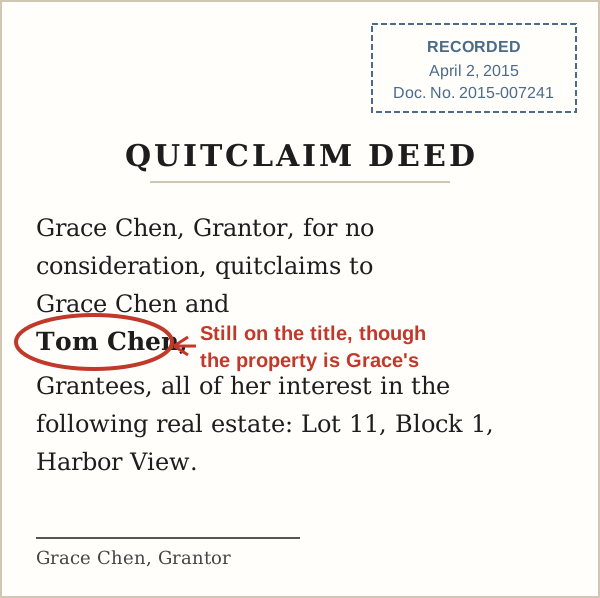
The recorded deed, 2015
Grace Chen, Grantor, for no consideration, quitclaims to Grace Chen and Tom Chen, Grantees, all of her interest in the following real estate:
Lot 11, Block 1, Harbor View, as shown on the recorded plat.
Recorded April 2, 2015, as Document No. 2015-007241.
Tom's quitclaim deed to Grace
Tom Chen, Grantor, for no consideration, quitclaims to Grace Chen, Grantee, all of his interest in the following real estate:
Lot 11, Block 1, Harbor View, as shown on the recorded plat.
The Grantor took his interest by the deed recorded April 2, 2015, as Document No. 2015-007241. Nothing is paid for this deed.
Why does a quitclaim deed work here?
A quitclaim deed passes whatever interest its signer has, without promising there's anything to pass. That's exactly what's needed when someone is on the title but the property isn't really theirs: whatever share the record gives them comes to you, and the record shows it. It's the deed people use to clear a claim like this off a title.
The same deed works for anyone whose name lingers on the title: a former partner, a relative who may have inherited a share, or a friend who co-signed years ago. If the person is a former spouse after a divorce, removing an ex-spouse from a deed covers the divorce side of it.
What about the mortgage?
If there's a mortgage, the quitclaim deed changes the title, not the loan. Whoever signed the loan still owes it after the deed is recorded, and taking someone off the loan is a separate arrangement with the lender.
What if they can't be found, or won't sign?
A quitclaim deed needs their signature. Without it, a quiet title case is the court route: it asks a judge to declare that the other person's claim isn't valid.
Taking a name off the title, step by step
- Order a copy of the deed that put both names on the title from the county where the property is located; the new deed repeats its legal description and cites its recording number.
- Prepare a quitclaim deed from the person whose name is coming off, to you.
- The person coming off the title signs before a notary, plus any witnesses your state requires.
- Complete the transfer tax form, if your state has one. Some states exempt transfers between close relatives (Pennsylvania's exemption includes brothers and sisters), and your state's guide lists who counts.
- Record it with the county office that recorded the deed carrying both names.
🛟 Need a little extra help? Our Quitclaim Deed Help page lists state-specific quitclaim deed forms, a deed preparation service and online notarization.
Common Questions
How do I get someone's name off my property title?
They sign a quitclaim deed to you in front of a notary, and it's recorded in the county where the property is located. Whatever interest the record gave them passes to you.
Does taking them off the title take them off the mortgage?
No. The quitclaim deed changes who owns the property, not who owes the lender. Removing a borrower from the loan is up to the lender.
Can I take their name off without their signature?
Not with a deed. Without their signature, a quiet title case asks a court to declare their claim invalid.
Where These Rules Come From
This page covers every state, so the laws below are examples, alongside the government pages behind the general points. Each citation, such as D.C. Code § 47-902, works like a street address for the law: which code, then which section. You don't need any of them to follow the page; they're here so you can check the wording yourself. Every name below links to its official text in a new tab.
- U.S. Bureau of Land Management, Title Training, Module 2 — a quitclaim deed conveys only the grantor's present interest, if any, and is frequently used to acquire outstanding interests clouding a title.
- Lake County, Ohio, Court of Common Pleas: What is a quiet title case? — how one court describes the case it hears to clear an invalid claim from a title.
- Act 2 of 1971, the Tax Reform Code, § 1102-C.3(6) — Pennsylvania's exclusion for transfers between family members, including between a brother and sister.
Rules on this page checked against the sources listed here on October 14, 2026.
A note on what this page is. This is general educational information, not legal advice, and reading it does not create an attorney-client relationship. Rules on fixing and re-recording deeds vary considerably by state and change over time. For advice about your specific situation, consult a qualified professional licensed in the state where the property is located.