How to Fix a Mistake in a Deed's Legal Description
Last updated: October 14, 2026
A mistake in a deed's legal description is fixed with a new quitclaim deed. The legal description is the part of the deed that identifies exactly which land it covers, such as a lot, block and subdivision, or a surveyor's measurements. The grantor signs a new quitclaim deed with the description copied correctly, in front of a notary, and it's recorded in the same county as the first.
An example: Lot 27 typed as Lot 72
Linda Park deeded her property to her son, Daniel, in 2024. Her land is Lot 27, Block 5, Cedar Hollow Addition, but the deed was typed with the lot number reversed, as Lot 72. Linda is glad to sign again, so the fix is a new quitclaim deed from Linda to Daniel describing Lot 27.
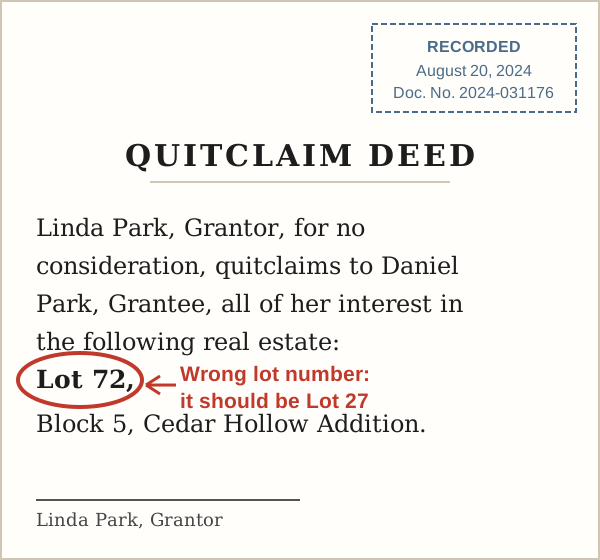
The recorded deed, with the mistake
Linda Park, Grantor, for no consideration, quitclaims to Daniel Park, Grantee, all of her interest in the following real estate:
Lot 72, Block 5, Cedar Hollow Addition, as shown on the recorded plat.
Recorded August 20, 2024, as Document No. 2024-031176.
The new quitclaim deed that fixes it
Linda Park, Grantor, for no consideration, quitclaims to Daniel Park, Grantee, all of her interest in the following real estate:
Lot 27, Block 5, Cedar Hollow Addition, as shown on the recorded plat.
This deed is given only to fix the lot number in the deed recorded August 20, 2024, as Document No. 2024-031176, which described the property as Lot 72. Nothing is paid for it.
Where does the correct description come from?
From the deed the grantor received when they acquired the property, which is on record in the same county. For a subdivision lot, the recorded plat, the surveyed map of the subdivision, shows the lot and block too. Copy the description word for word, so the new deed matches the land records exactly.
A street address isn't enough. It can change, and it doesn't say where one property ends and the next begins, which is the job the legal description does.
What if the wrong lot number belongs to another property?
Look up who owns the lot the mistake names. If it belongs to someone else, the grantor never owned it, so the first deed couldn't pass it: a quitclaim deed passes only what its signer holds. The new deed simply describes the right lot.
If the grantor owns both lots, the first deed may have passed the wrong one, and putting both lots right can take more than one deed, including one from the grantee giving back the lot that was never meant for them. Texas, for example, treats a fix like that as one everyone on the first deed has to sign.
What if part of the land was left out?
A new quitclaim deed from the grantor can describe the whole property. Because it passes land the first deed didn't, it's more than a fix to the paperwork: in Pennsylvania, a deed that adds to what the first one passed doesn't get the exemption for a deed fixing an earlier one, and in Texas every party to the first deed signs it.
Fixing a legal description, step by step
- Get copies of the recorded deed with the mistake and of the grantor's own earlier deed, or the recorded plat, from the recording office in the county where the property is located.
- Prepare a new quitclaim deed from the same grantor to the same grantee, with the correct description copied word for word and a line saying what it fixes, giving the earlier deed's recording information.
- The grantor signs it in front of a notary, along with anyone else your state's law adds, and any witnesses it requires.
- Fill in any transfer tax return your state requires, claiming its exemption for a deed fixing an earlier one if your state has one and the land hasn't changed.
- Have the signed deed recorded in the county that holds the first deed's record.
🛟 Need a little extra help? Our Quitclaim Deed Help page lists state-specific quitclaim deed forms, a deed preparation service and online notarization.
Common Questions
What is a legal description on a deed?
It's the part of the deed that identifies exactly which land is being transferred, usually by lot, block and subdivision or by a surveyor's measurements. It comes from the earlier deeds and the recorded plat, not from the street address.
Who signs the deed that fixes a legal description?
The grantor signs it, before a notary, just as they signed the first one. Where the fix adds or removes land, Texas requires everyone who was a party to the first deed to sign.
Will I owe transfer tax on the new deed?
Not where your state exempts a deed fixing an earlier one, nothing is paid, and the land described doesn't grow or shrink. Pennsylvania's exemption, for one, doesn't cover a deed that adds to what the first deed passed.
Where These Rules Come From
This page covers every state, so the laws below are examples, alongside the government pages behind the general points. Each citation, such as D.C. Code § 47-902, works like a street address for the law: which code, then which section. You don't need any of them to follow the page; they're here so you can check the wording yourself. Every name below links to its official text in a new tab.
- Tex. Prop. Code §§ 5.028–5.029 — Texas treats a wrong lot number as a clerical slip, but adding or removing land, or swapping one of the grantor's lots for another, must be signed by every party to the first deed or their heirs or successors.
- Act 2 of 1971, the Tax Reform Code, § 1102-C.3(4) — Pennsylvania's exclusion for a transfer for no or nominal payment that corrects a recorded transfer without extending or limiting the title.
- 30 Del. C. § 5401 — Delaware exempts correctional deeds given without payment.
- D.C. Code § 47-902(8) — in the District of Columbia, a transfer correcting or confirming a recorded one, with no further payment, is exempt.
- N.H. RSA 78-B:2, V — New Hampshire's transfer tax doesn't reach a deed correcting an earlier deed.
- U.S. Bureau of Land Management, Title Training, Module 2 — a quitclaim deed conveys only the grantor's present interest in the land, if any.
Rules on this page checked against the sources listed here on October 14, 2026.
A note on what this page is. This is general educational information, not legal advice, and reading it does not create an attorney-client relationship. Rules on fixing and re-recording deeds vary considerably by state and change over time. For advice about your specific situation, consult a qualified professional licensed in the state where the property is located.